Betting on the Future - The Boris Philosophy
Part 5: The "Studio" Yelp - Betting on the Future
The Story So Far: 11 days of madness turned into a full month of orchestration. We have a 3D studio that actually works. But why did we do it?
The Second "Yelp" Moment
If the first yelp was for the skybox, the second—much louder—yelp was for the Game Studio.
The Setup: January 22, 2026. I'm staring at an iFrame. Inside that iFrame is a Babylon.js scene. Inside that scene is a 3D character we generated 5 minutes ago, standing in a nebula we dreamed up 10 minutes ago, running code the AI agent just "linked" together.
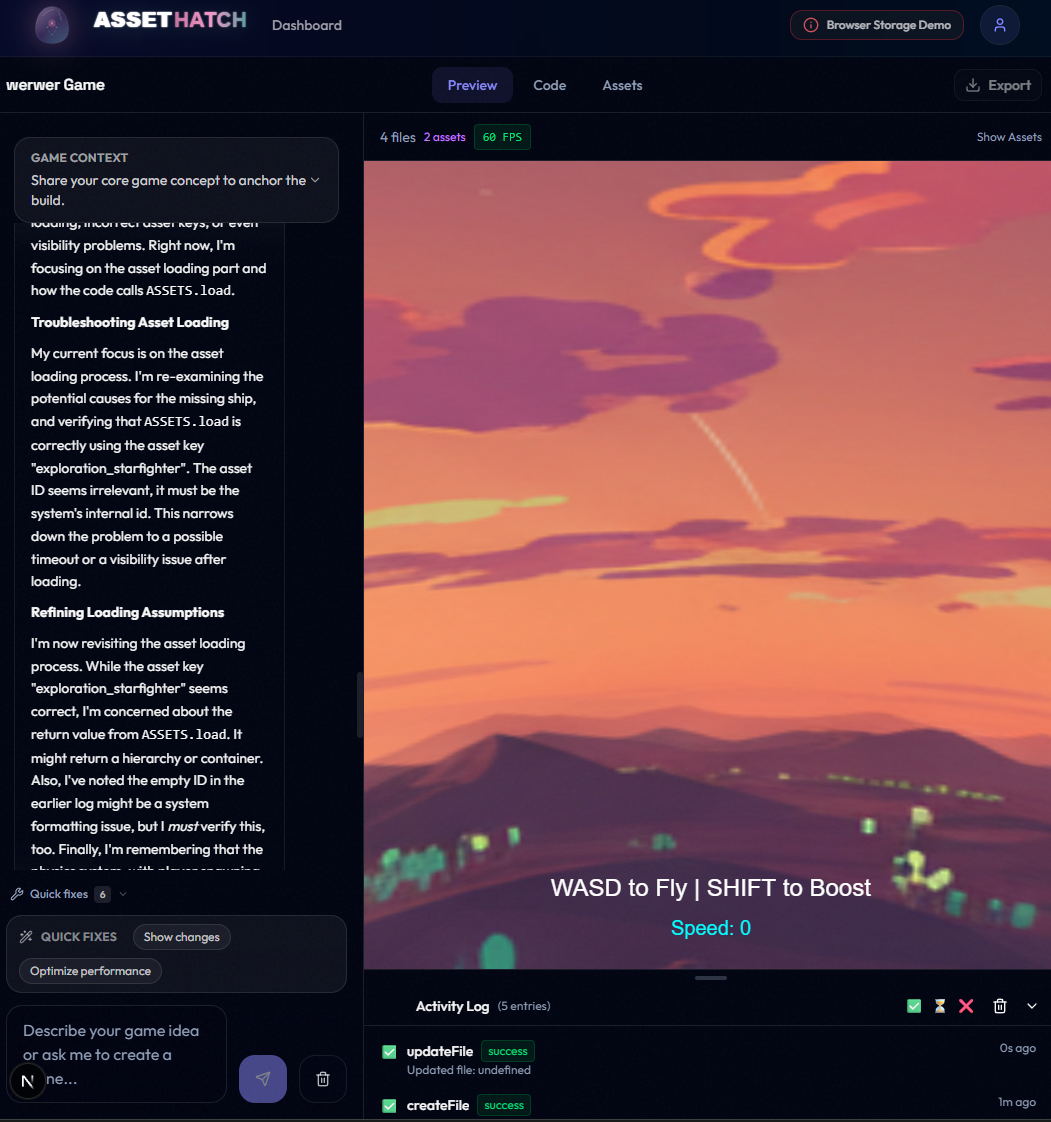
I clicked the "Play" button. The character moved. The logic held. For a split second, the orchestration was perfect. I built an entire asset studio in 11 days, but I spent the rest of the month building the Orchestration Layer. I realized that if I could do this in a month, the barrier to entry for game development wasn't just lowered—it was obliterated.
The "Good Enough" Trap
People asked me: "Why build Hatch-Studios now? The models aren't good enough to make a AAA game yet."
They're right. Today’s models struggle with complex game logic. They make mistakes. They need me to manage them like a team of junior devs.
But I’m not building for today's models. I’m building for tomorrow’s.
The Boris Philosophy
I’ve been following the work of folks like Boris Cherny @bcherny (creator of Claude Code) and the Anthropic team. Their philosophy is simple: Bet on the future.
Build a system that "kinda works" with today's intelligence. Build the scaffolding, the orchestration layer, and the UI. Because when the models of 2027 arrive—the ones that are smart enough to build AAA games—they won't need to invent a game engine.
They’ll just plug into the cockpit I’ve already built.
Hatch-Studios is the Scaffolding
That’s what Hatch-Studios really is. It’s a functional bet.
We’ve solved the "hard" infrastructure problems:
- Consistent 3D Generation (Tripo3D)
- Immersive Environments (Gemini Panoramas)
- Multi-file Orchestration (Ordered Concatenation)
- Mobile UX (Because the best dev you can be works everywhere)
When a model comes along that can understand a 100,000-line game project, it will find a home in Hatch-Studios. It will find a system that already knows how to link assets, manage versions, and preview in real-time.
The Reality of AI Orchestration
This month-long sprint taught me that the role of the developer is changing. I’m no longer the one typing out every line of code. I’m the Architect of Intention.
My job is to:
- Define the Vision: (Hatch-Studios, not just a generator).
- Enforce the Standards: (Strict types, ADRs,
src/memory). - Validate the Output: (Call the AI on its bullshit).
If I hadn't been vigilant—if I hadn't forced the AI to follow "Best Practices" like BYOK security and mobile responsiveness—I’d have a beautiful birdhouse that falls over. Instead, I have a Studio.
The Final Word
Hatch-Studios is a ridiculous project. It's a massive overhaul. It's an 11-day dusk-to-dawn expedition that turned into a month of deep orchestration.
But it's the logical next step. Because the future isn't flat, it isn't manual, and it isn't slow. The future is orchestrated.
See you in the third dimension.
Commit References:
945b055- Final auth and security hardening for Open Sourceefbac5c- Implement BYOK encryption strategy
Related Files:
src/memory/adr/029-byok-encryption.mdREADME.md- The Hatch-Studios Vision
Code: Asset-Hatch README
This concludes the "From 2D Asset to 3D Studio" saga. Thank you for following the journey.
Jordan Hindo
Full-stack Developer & AI Engineer building in public. Exploring the future of agentic coding and AI-generated assets.
Get in touch