Genesis - The Ridiculous Pivot to Hatch-Studios
Part 1: Genesis - The Ridiculous Pivot to Hatch-Studios
The Story So Far: Asset Hatch is done. It works. It’s consistent. I should be celebrating, but I’m already bored.
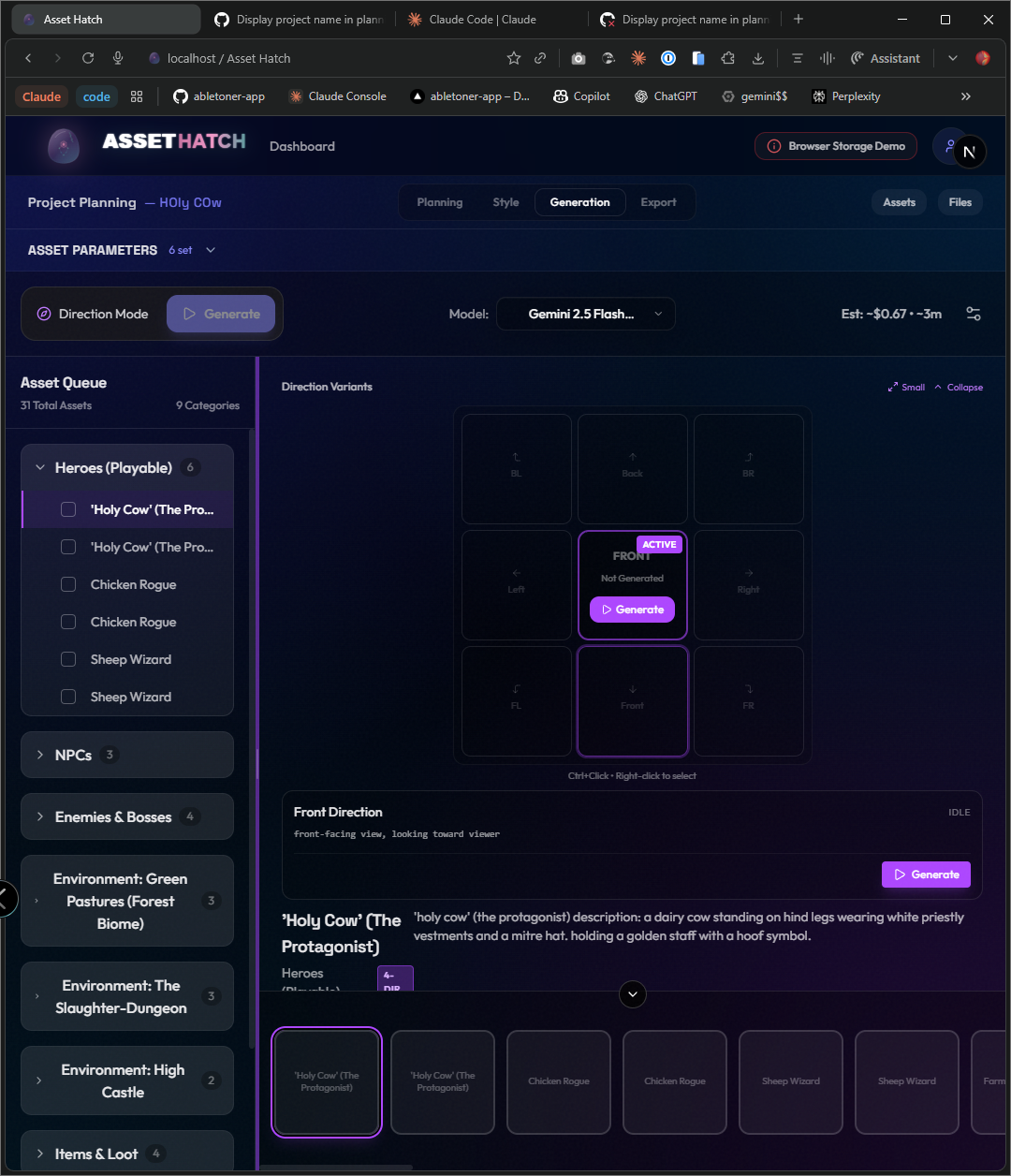
The "Why Stop There?" Moment
The Setup: January 12, 2026, 2:14 AM. I’m staring at a perfectly generated 2D sprite of a sci-fi crate. It’s exactly what I asked for.
And that’s the problem. It’s just a sprite.
I built an entire asset studio in 11 days. The momentum is a drug at this point. I started asking myself the dangerous question: If I built an entire asset studio in 11 days, what could I make in a month?
The Vision: Hatch-Studios
The goal shifted overnight. We weren't building a "sprite generator" anymore. We were building the Orchestration Layer for the future of game dev.
The philosophy is simple: Bet on the future.
Top leaders in AI (and Boris from Claude Code) say the same thing: Build something that "kinda works" now, so that when the models that can dream up entire AAA worlds arrive—they already have a cockpit to live in.
Alas, the concept for Hatch-Studios was born. The Idea: build the scaffolding for the future of game development. A system where:
- AI creates the assets (2D, 3D, Skyboxes).
- AI creates the game logic.
- The "Studio" makes them all talk to each other.
Managing the "Gaslighting" Junior Team
Here’s the reality of "AI-First" development: I’m not just a dev; I’m a AI Orchestrator managing a team of brilliant, lazy, gaslighting agents.
Claude Code and Gemini are geniuses, but they want to be done with the chat. They will:
- Use
anytypes to avoid thinking. - Tell me a feature is "implemented" when they just wrote a comment.
- Skip documentation because "it's obvious."
Orchastrating AI to effetively produce working, production-grade appications requires a keen eye for BS.
I had to become a Digital Dictator. I established src/memory as the absolute source of truth and built pre-commit commands that I send off to assure the docs are updated and all checks pass. If the docs aren't updated, the commit doesn't happen.
Using my multi-agent pipeline, along with the newcomer OpenHands ( a wonderful agent that lives in Slack, GH, Jira, etc) I was able to bully these babies into wiring up the vision I set.
The Initial Stake in the Ground
commit 2d3f4a1
Author: zenchantlive
Date: 2026-01-12

feat(3d): [Phase 1] Initialize 3D Mode foundation and Tripo3D client
Underwhelming? Maybe. But this was the moment Asset Hatch died and Hatch-Studios was born.
What I Learned in Day 1
1. The Ceiling is Moving
If you build for today's models, you're building a legacy system. You have to build for the "Next Model." Hatch-Studios is a bet that "AAA from a prompt" isn't a pipe dream—it's an inevitability.
2. Guardrails are Freedom
The more I restricted the AI (strict types, ADRs, mandatory checks), the faster we moved. Constraints eliminate the "hallucination space."
3. Intent is the New Code
My job isn't writing functions anymore; it's Architecting Intent. If I can't explain the system to the agents, the agents can't build it.
Commit References:
2d3f4a1- Initial 3D Mode foundation
Related Files:
src/memory/adr/023-3d-mode-foundation.md- The decision to pivot
Code: lib/tripo/client.ts
This is Part 1 of a new saga: From 2D Asset to 3D Studio. We're adding a dimension, and things are about to get complicated.
Jordan Hindo
Full-stack Developer & AI Engineer building in public. Exploring the future of agentic coding and AI-generated assets.
Get in touch